
Production Systems
Indirect Fired Heater
Water Bath Heaters are designed to heat high-pressure fluids and gas coming from the well or pipeline. Water bath heaters (water jacket furnace) are used in the oil and gas industry for heating the medium of the pipeline to prepare for further technological needs.
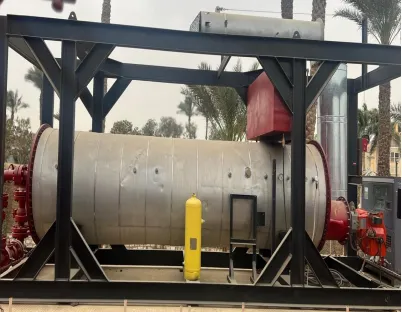
Water Bath Heaters are designed to heat high-pressure fluids and gas coming from the well or pipeline. Water bath heaters (water jacket furnace) are used in the oil and gas industry for heating the medium of the pipeline to prepare for further technological needs. It is also called an indirect bath heater.
The configuration of the heater may differ depending on the process application. Usually, the heater consists of a main body with coil tubes, a burner, a firetube, and a flue stack. Sometimes, a skid may include an expansion tank.
The main body refers to the basic vessel into which the firetubes and process coils are inserted from opposite ends. The burner ignites the fuel gas or fuel oil and blows it into the firetube to heat the water in the vessel, and the hot water heats the medium in the coils, such as crude oil or raw natural gas. The process coils are “bathing” in the water, and that’s why it’s called a water bath heater.
The outlet temperature may vary, but usually doesn’t exceed 86-88 °C.
Indirect-gas or diesel-fired heaters consist of a large, low-pressure tank that contains water or glycol heated by a gas or diesel burner in a tube. The fluid to be heated passes through high-pressure flow tubes or coils, which are installed in the tank and covered by water or glycol. The coils make multiple passes inside the tank to provide the largest amount of surface area possible for heat transfer.
All Apex heaters incorporate a split-coil design with preheat and post-heat coils. The preheat coils heat the well effluent before it passes through a choke. The post-heat coils reheat the well effluent after it has passed through the choke.
*Meets requirements of NACE MR-01-75
Other sizes, configurations, and pressure ratings are available to meet most applications. These ratings are guidelines only. For more information, contact your local Apex representative.
Key features
- Features a split-coil design, which allows more efficient thermal conductivity and reduced pressure drop through the coil package.
- Features a modular design with a box beam container, which conforms to ISO specifications for improved portability.
- Available for gas-fired, oil-fired, and electric for maximum flexibility.
- Has a bypass manifold, which helps during cleanup by reducing damage to coils.
- Equipped with built-in control and safety shutdowns as an integral part of the design.
- Meets applicable industry standards.
- Can be third-party certified.
Specifications
Scroll horizontally to view the complete table
| Capacity Btu/hr | 2 million Oil Fired | 3 million Oil/Gas Fired | 3 million Oil/Gas Fired |
|---|---|---|---|
| Pressure Rating (psi) (bar) | 5,000 (344.74) | 5,000 (344.74) | 10,000 (689.48) |
| Preheat Coils | 14-3-in. XXH | 16-3-in. XXH | 14-4-in. OD x 2.5-in. ID |
| Preheat Coils Rating psi (bar) | 5,000 (344.74) | 5,000 (344.74) | 10,000 (689.48) |
| Post-heat Coils | 8-4-in. XH | 10-4-in. XH | 8-4-in. XH |
| Post-heat Coils Rating psi (bar) | 2,000 (137.90) | 2,000 (137.90) | 2,000 (137.90) |
| Choke psi (bar) | 2 in. 5,000 (344.74) | 2 in. 5,000 (344.74) | 2 in. 10,000 (689.48) |
| Service | H2S* | H2S* | H2S* |
| Heater OD (in. cm) | 68 (122) | 72 (183) | 72 (183) |
| Skid Length (in. cm) | 359.25 in. (912) | 359.25 in. (912) | 359.25 in. (912) |
| Skid Width (in. cm) | 96 (244) | 96 (244) | 96 (244) |
| Skid Height (in. cm) | 114 (290) | 114 (290) | 114 (290) |
| Skid Weight (lb. kg) | 30,000 (13,608) | 37,000 (16,783) | 38,000 (17,237) |
| Inlet | 3 1/8-in. 5K c/w 3-in. 602 (T) XO | 3 1/8-in. 5K 3-in. 602 HU (T) XO | 2 9/16-in. 10K 3-in. 1502 (T) XO |
| Outlet | 3 1/8-in. 5K R35 c/w 3-in. 602 (W) XO | 4-in. – 900 lb RTJ c/w 4-in. 602 (W) XO | 4-in. – 900 lb RTJ c/w 4-in. 602 (W) XO |
| Drain | 2-in. – 150 lb | 2-in. – 150 lb | 2-in. – 150 lb |
Related products
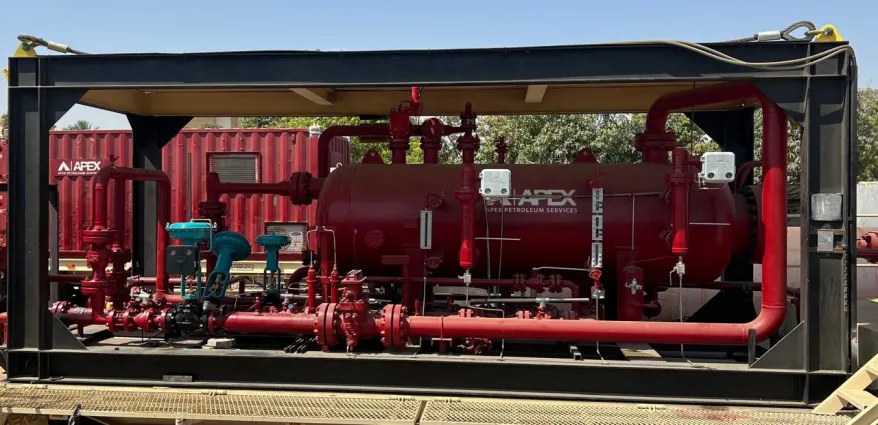
Horizontal Test Separator
The Apex Petroleum Services three-phase horizontal well testing separator is designed to separate and measure the gas, oil, and water produced from a well. This separator can be used in well testing and to clean up new completions or stimulated wells.
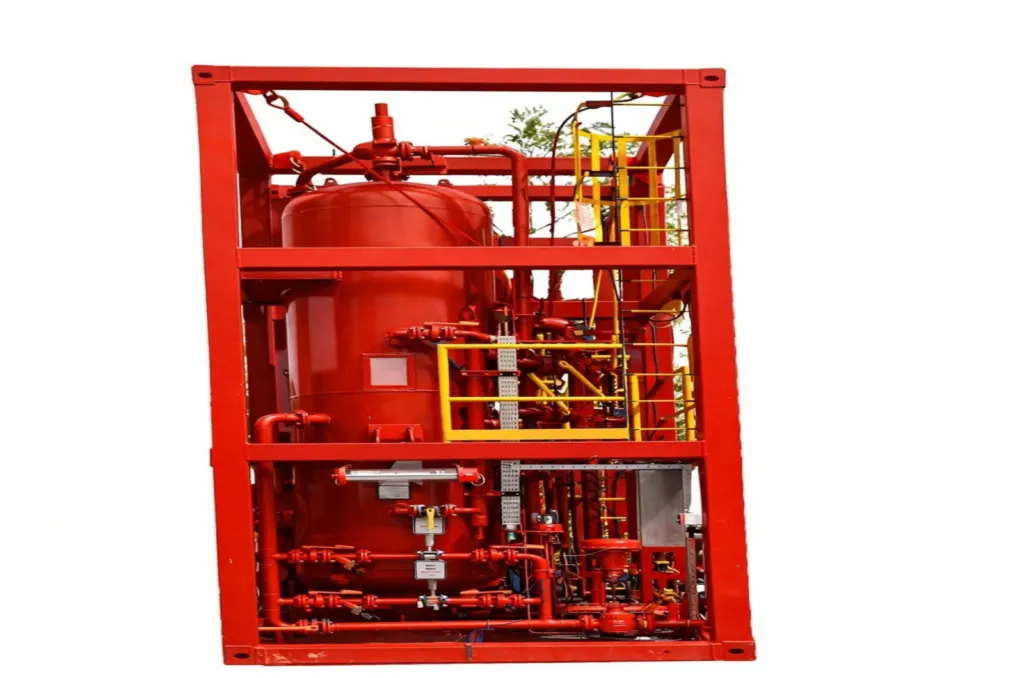
Vertical Separator
The Apex Vertical Separator is engineered for high-performance separation of liquids from produced gas, particularly suited for wells with low to moderate liquid content. Its compact and lightweight design makes it ideal for operations where space, mobility, and efficiency are key.
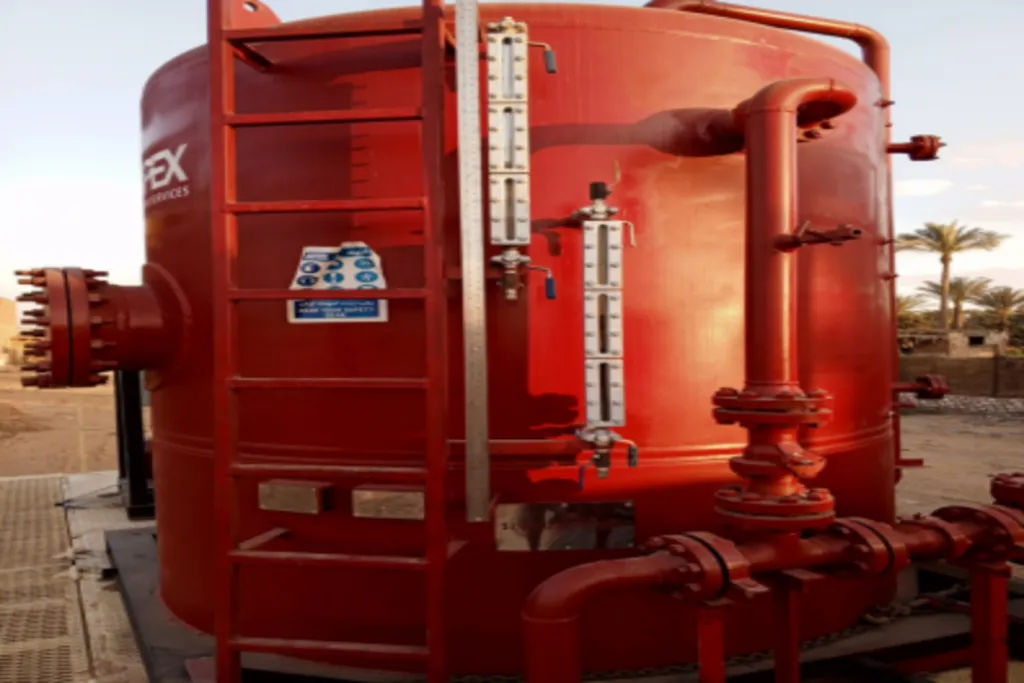
Surge Tank
The Apex Pressurized Test Tank is used to store produced liquids before they are disposed. It can also be used as an additional stage of separation.
Need this equipment on site?
Talk to our engineering team about specifications, availability, and deployment.